
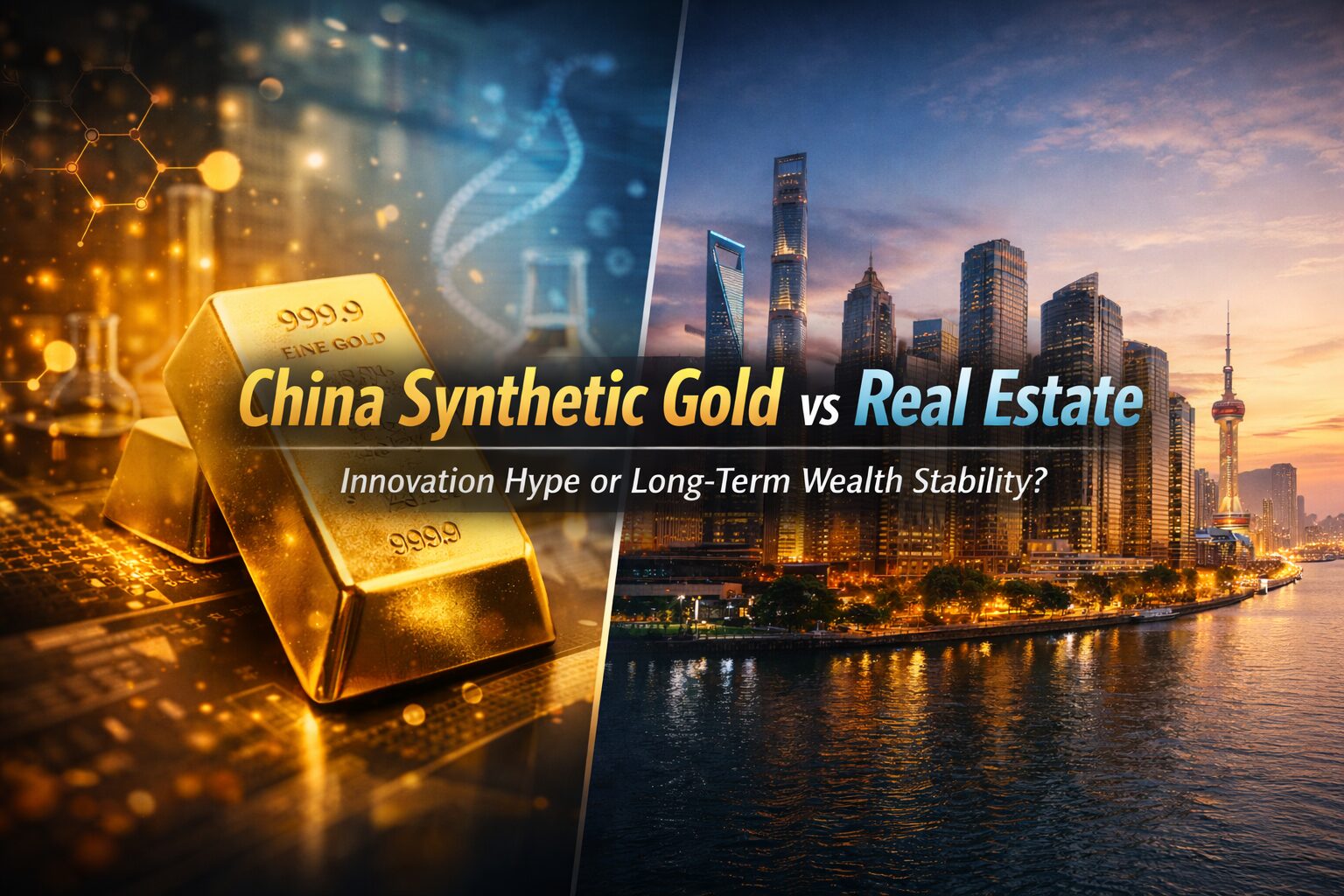
In recent months, financial headlines around the world have buzzed with talk about China’s advances in gold production and innovation. From reports of new forms of high-purity gold to investors exploring alternative assets, the country’s approach to precious metals has sparked intense debate among global investors. At the same time, China’s real estate sector – long considered a cornerstone of wealth creation – continues to face pressure and slow growth.
Against this backdrop, many investors are asking an important question: Is China synthetic gold vs real estate a fair comparison, and which investment is better positioned for the future? In this blog, we dive deep into both sides of the argument, explain the developments in China’s gold markets, and ultimately make the case that real estate investment remains a more reliable long-term wealth creator than gold, despite recent trends.
What Is China’s Synthetic Gold Development?
Reports have recently circulated – often with sensational language – about China making breakthroughs in producing new types of gold that are stronger or purer than traditional bullion. Some sources have described innovative forms of gold jewellery with enhanced physical properties showcased at industry events.
Although this isn’t “synthetic gold” in the sense of lab-created elements that replace real gold at scale, such innovations represent an evolution in how precious metals are processed and marketed in China. They reflect broader advances in material science and the incorporation of new technologies in the traditional gold sector. The result is increased interest in gold-related products, both for aesthetic and investment purposes.
This type of innovation has attracted consumers and investors alike and is often cited as a reason for renewed enthusiasm toward gold, especially among younger buyers. Nevertheless, even with such products gaining attention, gold remains fundamentally a precious metal whose value is driven by global demand, supply dynamics, and investor sentiment, rather than its physical utility in the economy.
Why Is Synthetic Gold Creating Market Buzz?
The idea of “synthetic gold” – or enhanced forms of gold – generates excitement because it combines technological novelty with something culturally familiar. Gold has long been one of the world’s most storied assets, prized for millennia across cultures as a store of value and symbol of wealth.
In China, gold holds a dual identity. It is both a cultural asset and a significant economic investment. Chinese consumers account for a huge share of global gold jewellery demand, and there has been a growing trend among retail investors to buy gold in small, affordable forms – such as tiny “gold beans” – which have become especially popular among younger demographics seeking diversification during uncertain times.
At the same time, Chinese financial institutions have introduced gold-linked structured deposits and other products tied to gold prices, drawing investors seeking alternatives to low-yield cash deposits. These innovations contribute to the narrative that gold is evolving beyond a simple metal into a broader investment asset class.
However, it’s important to separate buzz from substance. While these developments shift how gold is marketed and traded, they do not fundamentally change how gold behaves as an investment compared to real assets such as property.
Can Synthetic Gold Disrupt Traditional Gold Markets?
Even though innovations in gold craftsmanship and new investment products generate interest, they do not fundamentally alter gold’s core investment profile. Gold, whether traditional or technologically enhanced, remains a commodity whose price is influenced by global supply and demand, currency movements, inflation expectations, geopolitical uncertainty, and investor risk appetite.
Moreover, gold markets have shown signs of volatility recently. For example, some trading platforms in China experienced liquidity problems when investors rushed to cash in on surging gold prices, causing significant losses for customers and highlighting the risks associated with speculative gold investment vehicles.
Additionally, Chinese banks and regulators have sometimes taken steps to manage how people invest in physical gold, indicating that gold investment is not always unrestricted or straightforward.
All of this underscores that while synthetic gold innovations and gold-linked financial products may attract attention, they do not fundamentally disrupt the long-standing dynamics of the precious metals market, nor do they diminish investment risks. These developments may change how investors access or buy gold, but they don’t make gold a superior wealth-creating asset compared to property.
China Synthetic Gold vs Real Estate – A Direct Comparison
When comparing china synthetic gold vs real estate investment, it helps to look at key investment characteristics:
| Feature | Enhanced Gold / Gold Investments | Real Estate |
| Tangibility | Physical but not productive | Tangible and productive |
| Income Generation | No passive income | Rental income potential |
| Liquidit | Usually liquid, depending on form | Illiquid but stable over time |
| Price Drivers | Market sentiment & commodity demand | Local economic growth & urbanisation |
| Risk Factors | Price volatility & scams | Market cycles & policy changes |
While gold and related investment products can be liquid and accessible, they rarely generate consistent income. On the other hand, real estate – whether residential or commercial – can produce sustained rental income and benefits directly from demand growth due to population increases, urbanisation, and economic development.
Why Real Estate Remains a Tangible Wealth Asset
Despite ongoing interest in gold, real estate continues to be one of the most powerful and enduring asset classes for building wealth, especially in rapidly urbanising economies like China.
Real estate has intrinsic utility. Houses, apartments, and commercial properties serve real economic functions – people need homes, retail spaces, warehouses, and offices. This fundamental demand differentiates property from commodities like gold, which hold value primarily because people assign value to them.
Real estate also benefits from leverage – the ability to use borrowed capital to acquire property. When used wisely, leverage can significantly amplify returns. For example, a partial down payment backed by financing can allow an investor to own a high-value asset with relatively smaller initial capital, a strategy not possible with physical gold without using derivatives or complex financial products.
Rental Income Advantage: What Gold Cannot Offer
One of the most compelling reasons to favour real estate over gold is the potential for passive income. Rental income from residential or commercial properties can provide a steady cash flow year after year. This income can be reinvested, used for lifestyle support, or deployed into additional investments.
Gold, by contrast, does not generate rent or dividends. Its return comes solely from changes in price, which can be volatile and influenced by global macroeconomic events that are often unpredictable.
In uncertain economic environments, properties that are well located and well managed can provide defensive value. Even if prices stagnate temporarily, rental income helps bridge downturns, offering a cushion that gold investments cannot match.
Long-Term Real Estate Investment vs Gold Volatility
Gold prices are known to rise during periods of economic fear or inflation, but these price movements can be sudden and are often driven by short-term market sentiment. Real estate markets, while subject to cycles, typically reflect long-term demographic trends and structural economic growth.
For example, China’s urbanisation and internal migration continue to fuel demand for housing in major cities, a trend supported by decades of economic development. Property remains central to household wealth for many Chinese families, despite occasional slowdowns or policy adjustments.
By contrast, gold investment may spike when investors seek a haven amid market uncertainty, but it often lacks a consistent growth trajectory tied to underlying economic expansion. Gold investments tend to fluctuate based on broader global financial conditions rather than local economic fundamentals.
Economic Stability and the Future of Property Investment
Despite occasional slowdowns and concerns about the property sector’s performance in China, real estate still plays a central role in economic growth and wealth distribution. Governments often implement policies to stabilise housing markets because property value affects consumer confidence, financial stability, and even social well-being.
Furthermore, property investment is rooted in the everyday lives of millions. People buy houses for living, renting, and retirement planning. This fundamental connection between real estate and human needs makes property a more predictable and grounded investment over the long term compared with commodities, which are essentially traded based on perception and speculation.
Why Real Estate Still Wins in the Long Run
At a time when developments around gold – including new products and investor enthusiasm – are making headlines, it’s natural to wonder whether traditional stores of value are being challenged. But when you consider the core strengths of real estate, the comparison becomes clear:
Property generates income. Property fulfils real human needs. Property appreciates with economic development.
These fundamental advantages make real estate a more compelling investment choice for long-term wealth building compared to gold or any form of enhanced gold products.
Even as investors explore new forms of precious metal investments and financial innovation in the gold sector continues, the stability, income potential, and enduring demand for real estate make it a stronger investment for the future.
If you’re looking to build lasting wealth rather than chase short-term trends, real estate remains the foundation for a strong financial future.
Why Smart Investors Choose Siddharth Group India for Long-Term Property Investment
While comparing china synthetic gold vs real estate investment, one important factor often gets overlooked: the quality of the real estate developer you invest with.
At Siddharth Group India, we focus on long-term value creation through strategically located residential and commercial developments designed for sustainable appreciation and rental potential.
For investors seeking stable residential assets in high-growth markets, we offer premium housing options, including:
Each property category is thoughtfully developed to cater to modern lifestyle needs while ensuring strong long-term investment fundamentals.
Our projects are developed keeping in mind:
- Prime growth corridors
- Future infrastructure development
- High rental demand zones
- Transparent legal compliance
- Long-term asset appreciation
In an investment environment filled with speculative products and volatile asset classes, real estate backed by strong fundamentals and experienced developers provides stability and measurable returns.
For investors seeking reliable property assets rather than commodity-driven fluctuations, Siddharth Group India represents a practical path toward structured wealth creation in one of Uttarakhand’s fastest-growing cities.
FAQs
Q1. What is meant by synthetic gold in China?
Synthetic gold in China generally refers to technologically enhanced or newly processed forms of gold developed through advanced material science. It does not mean mass-produced artificial gold replacing natural gold, but rather innovation in purity, strength, or gold-linked financial products.
Q2. Can synthetic gold reduce the value of traditional gold?
Currently, there is no strong evidence that enhanced or lab-related gold developments can significantly reduce the global value of traditional gold. Gold prices are primarily influenced by global demand, supply, inflation trends, and geopolitical conditions.
Q3. Is gold a safer investment than real estate during economic uncertainty?
Gold is often considered a short-term hedge during market instability. However, real estate offers long-term advantages such as rental income, asset appreciation, and tangible ownership, which may provide more stable wealth creation over time.
Q4. Why do many investors still prefer real estate over gold?
Investors prefer real estate because it generates passive income, benefits from population growth and urbanisation, and serves a functional purpose. Unlike gold, property can produce a consistent cash flow through rent.
Q5. How does real estate perform compared to gold in the long run?
Historically, long term real estate investment has delivered steady appreciation along with rental income. Gold, while valuable, typically experiences price cycles and does not generate recurring returns.
Q6. Could China’s gold innovation impact the property market?
China’s advancements in gold technology may influence investor sentiment toward precious metals, but they are unlikely to directly disrupt the property market. Real estate demand is driven by housing needs, economic growth, and infrastructure development.
Q7. Which investment is better for building long-term wealth: gold or property?
For long-term wealth building, property investment is generally considered stronger because it combines appreciation potential with rental income and tangible asset ownership, whereas gold primarily serves as a store of value.